3. CALCULATION OF CONCENTRIC TUBES HEAT EXCHANGERS
3.4. Calculation general of concentric tubes heat exchangers
All double tube heat exchangers follow the methodology of calculation being different flow configurations.
This proposed the thermal balance equations for each fluid: q = W1 · Cp1 · (T1i -T10) q = W2 · Cp2 · (T20 - T2i) * If any fluid has a phase change: q = W· ∆Hphase change (3) Where (in units of International System (SI)):
|
(1) (2)
(3)
|
Then is proposed the general equation of heat pass: q = U0·A0·∆Tlog (if referred to the outer tube inside) q = Ui·Ai·∆Tlog (if referred to the inner tube inside) |
(4) (5) |
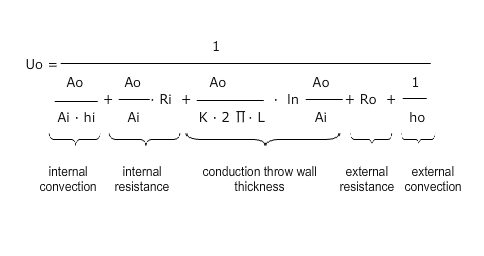
The global coefficient of heat transmission referred to the area outside the inner tube, U0, has the expression:
|
(7) |
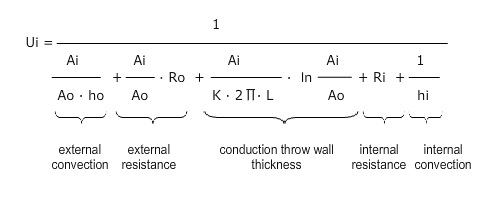
and the coefficient referred to the internal area:
|
(8) |
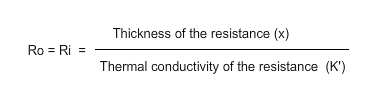
Ri and Ro are the resistances due to fouling occurring inside and outside the inner tube, which hinder the transmission of heat.
|
(9) |
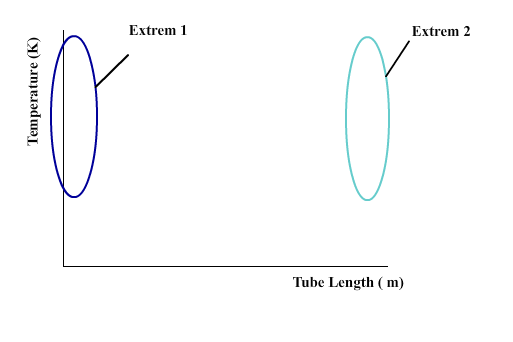
∆Tlog is:
The following chart you can see which are the two extremes (1 and 2) temperature of the above equation:
|
(10)
|
Where: Ao: Area outside the inner tube (m2) Ai: Area inside the inner tube (m2) hi: Convection coefficient inside of the fluid 1 (W/m2K) ho: Convection coefficient outside of the fluid 2 (W/m2K) K: Thermal conductivity of tube material (W/m·K) K' : Thermal conductivity of the resistance (W/m·K) L: Pipe length (m) Ro: resistance due to fouling of the outer fluid 2 (m2K/W) Ri: internal resistance due to fouling of the fluid 1 (m2K/W) X: Thickness of the resistance (m) |